Engine is Overheating: What Every Driver Must Do Right Now
When your engine is overheating, time becomes very valuable to you. Any inappropriate action, such as driving on or opening the radiator cap at the wrong moment, can lead to additional thousands of rupees or dollars in repair costs. Your cooling system, consisting of the radiator, coolant, thermostat, water pump, and cooling fan, works all the time to maintain the proper temperature in the engine.
The failure of any of those components causes quick heating. Fortunately, there are always warning signs before an engine overheats. Here, let’s talk about those signs, how you can handle this problem in case of an emergency, when it is safe to continue driving, and when it is better to use roadside assistance.
What Are the Warning Signs That Your Car Engine Is Overheating?
India has over 350 million registered vehicles on its roads, as per the Ministry of Road Transport and Highways’ Vahan database, and engine overheating remains one of the most common causes of roadside breakdowns. The risk is even higher on Indian roads: long hours in stop-and-go city traffic, extended highway drives in peak summer heat (when cities like Delhi, Nagpur cross 45°C and Chennai struggles with oppressive humidity), and frequent hill climbs in regions like the Western Ghats or the Himalayan foothills all put extra strain on your engine’s cooling system. To avoid getting stranded or causing permanent engine damage, you need to know what signs indicate an emergency.
Most cars display a number of symptoms to indicate when the engine is overheating. It is good to know what they are and take action before any irreversible damage is done.
- Temperature gauge near “H”: When the temperature gauge comes close to the red “H” sign on your car’s dashboard, immediately consider this seriously by stopping your car to let the engine cool.
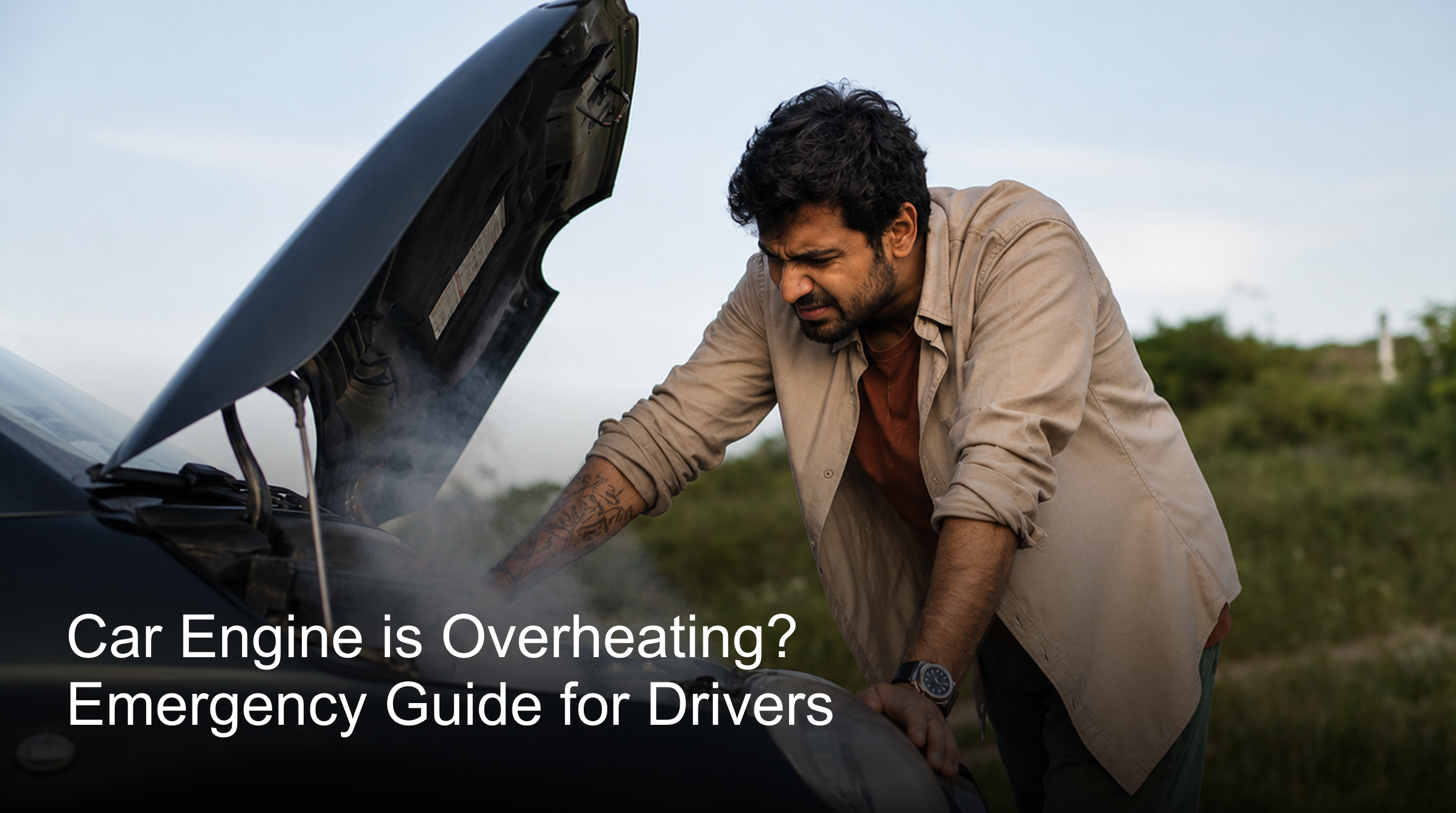
- Appearance of White Steam under the Hood: Do not drive if you notice visible steam, as it is an indicator that there is either a boiling coolant or a leakage in the engine parts
- Unusual odours: Immediately investigate the source of the odour if you get any type of unusual smell, such as burning plastic/rubber or a sweet smell.
- Loss of Driving Force: If your engine is running strangely and you notice an increase in the temperature gauge, then you have to stop driving immediately.
- Ticking or Knocking Sounds: If you hear any ticking or knocking noise, stop driving to avoid further damage.
What Does the Temperature Warning Light Actually Mean?
Usually, under normal operation, the engine operates at temperatures ranging from 90°C to 105°C. The temperature gauge is located somewhere in the middle of the dial.
When the needle reaches the red zone or when the coolant temperature warning light is lit, it shows that the engine is overheating and the temperature has exceeded its operating range.
Note that when the engine temperature briefly spikes while you are ascending a slope or pulling some cargo due to hard work, or when you are stuck in a traffic jam, it does not always indicate problems. However, if the needle stays constantly in the red zone and keeps on progressing, you need to pull over immediately.
Can You Keep Driving if the Engine is Overheating?
No, if you continue driving when the engine is overheating, it will lead to permanent damage to the engine within a few minutes. The only condition under which the driver can continue his ride is a slight increase in temperature without any steam, warning light, burning smell, or coolant loss. In such a case, it is possible to continue driving about 1-2 kilometres (up to 1-2 minutes) to a safe place, while monitoring the heat indicator.
What Should You Do Immediately When Your Engine Overheats?
In such an emergency situation, you will have to keep calm. Following these steps safely protects your car’s engine from further damage.
Step 1: Switch off the air conditioner to lower the engine load.
Step 2: Increase the heater to the maximum value in order to dissipate heat from the engine.
Step 3: Move your vehicle to the side and switch on hazard lights.
Step 4: Switch off the engine after coming to a halt.
Step 5: Do not touch the radiator cap immediately because the cooling system will be under pressure.
Step 6: Wait for some time to let it cool down before evaluation.
How Long Should You Wait Before Opening the Radiator Cap?
You should never attempt to remove the radiator cap when the engine is overheating because pressurised coolant might shoot out and burn you severely. You have to wait for 30-45 minutes or let the engine cool down entirely before checking your coolant level. While removing the cap, use a thick cloth and do it slowly to release pressure.
Should You Call Roadside Assistance or Try to Fix It Yourself?
It is the right time to call for roadside assistance if:
- Steam appears from under the hood.
- There is a burning smell.
- The engine makes knocking sounds.
- There are recurring engine overheating problems even after refilling the coolant.
However, you may drive carefully if:
- The overheating of the engine was not serious.
- There is no steam, burning smell, or coolant leakage.
- Your engine has cooled down completely.
- You refilled the coolant properly, and the engine heat does not spike thereafter.
What Are the Most Common Causes of Engine Overheating?
When the engine is overheating, it means that there is something wrong with the cooling system. The causes of engine overheating that drivers should know about are as follows:
- Low level of coolant: It is one of the most frequent reasons for the engine to overheat because there is not enough fluid to cool the engine.
- Coolant Leakage: If hoses are leaking, the radiator is cracked, or the radiator cap is faulty, it causes loss of coolant, which affects the function of the cooling system.
- Thermostat malfunction: The thermostat controls the flow of coolant, but if it gets stuck in the closed position, no coolant flows into the radiator.
- Water pump malfunction: The malfunction of the water pump results in the cessation of circulation and causes overheating.
- Clogged radiator: The clogging of the radiator occurs due to internal corrosion or rust blocking the way of the coolant, as well as broken radiator fins preventing the cooling of the coolant.
How Does a Coolant Leak Cause Overheating of an Engine?
Coolant flows through the engine, absorbs heat, goes to the radiator to dissipate the heat, and then it goes back again to cool down the engine. In case of a coolant leak, the process fails to work as the amount of coolant decreases, which hampers the cooling process.
- Signs of a coolant leak include;
- Noticing bright coolant under the vehicle
- Getting the smell of sweet liquid after the trip
- Having the coolant reservoir always at the minimum line.
If any of the signs appear, repair the leak instead of frequently adding new coolant.
What Does a Faulty Thermostat Do to Engine Temperature?
A thermostat is a kind of temperature-controlled valve. It remains closed during engine warming and starts opening when the engine reaches normal operating temperature to let the coolant go through the radiator. If the thermostat is stuck in the closed position, the heating process goes too fast, as there is no possibility for coolant circulation.
A positive point is that the thermostat is one of the cheapest parts in the cooling system. So, fixing it early can prevent far costlier repairs later.
How Do You Check and Top Up Coolant When the Engine Overheats?
You can only check the coolant once the engine has cooled down completely. For this, you will have to do the following;
- Find the coolant tank under the hood of the car.
- Check if the level of the coolant is within the range of the MIN and MAX marks.
- Replenish the coolant recommended by the manufacturer of your car.
- Top off the coolant slowly.
- Make sure the reservoir cap is well sealed before starting the engine.
What Type of Coolant Does My Car Need?
There are three types of coolant used in most cars:
- IAT (Inorganic Additive Technology)
- OAT (Organic Acid Technology)
- HOAT (Hybrid Organic Acid Technology)
Each type of coolant has its own additives; therefore, it is crucial not to combine them since this could damage your car’s cooling system and diminish corrosion protection.
Can You Use Water Instead of Coolant in an Emergency?
It is possible to use water temporarily in case of an emergency. In case of a lack of coolant and sudden overheating, filling the tank with clean water will let you drive to the nearest service station. However, water does not have the same anti-corrosive, anti-freeze, and lubricant qualities as the coolant. So, the cooling system should be drained, flushed, and refilled with the correct coolant as soon as possible.
How Much Does It Cost to Fix an Overheating Engine?
Fixing the damage when the engine is overheating costs money, but it really depends on what caused it. However, catching it early will save you lots of money on the repair.
| Repair | Cost Estimate (India) |
| Thermostat replacement | ₹800 – ₹2,500 |
| Coolant flush | ₹500 – ₹1,500 |
| Water pump replacement | ₹2,500 – ₹6,000 |
| Radiator replacement | ₹3,500 – ₹10,000 |
| Head gasket replacement | ₹8,000 – ₹25,000+ |
What Is a Blown Head Gasket and Why Is It So Expensive?
The head gasket creates a seal between the engine block and the cylinder head. If failure is caused by overheating, there will be a mixing of the coolant, engine oil, and gases, resulting in engine damage.
Symptoms of a blown head gasket are:
- White exhaust smoke
- Frothy engine oil
- Coolant loss
- Ongoing overheating of the engine
- Low engine performance
Will Car Insurance Cover Engine Overheating Damage?
Usually not. When the engine is overheating, it is considered a mechanical failure and not an accident; regular car insurance doesn’t cover engine damage.
But there are some insurers that provide engine cover as an add-on to their comprehensive car insurance coverage plan. In such situations, some kinds of overheating damage could be covered under the policy.
How Can You Prevent Your Engine from Overheating?
Preventing the engine of the car from overheating is always less expensive and much easier than fixing the entire engine. Here are some basic precautions that would help to avoid engine overheating in most cases.
- Ensure that the coolant level in your car is normal.
- Make sure that there are no leaks in the radiator, hoses, or coolant tank.
- Replace the defective thermostat or water pump.
- Watch out for the temperature gauge.
How Often Should You Flush the Coolant System?
Most car makers recommend that one flush the cooling system once every 2 to 5 years, depending on the type of coolant used and the type of car. After some time, the coolant becomes less efficient in dissipating heat and less effective in preventing the build-up of corrosion, making overheating more likely.
Does Driving in Summer or in Traffic Make Overheating More Likely?
Indeed, driving in summer, in stop-and-go traffic conditions, and idling for long periods lower the effectiveness of your cooling system due to reduced airflow around the radiator. To prevent overheating when going for a long summer drive, make sure you check your coolant, avoid unnecessary idling, and monitor your temperature gauge, particularly if driving on heavy traffic roads.
Conclusion: Act Fast, Prevent Early, and Never Ignore the Temperature Gauge
An overheated engine does not necessarily mean costly repairs, but ignoring warnings surely does. By acting on time and ensuring that your cooling system is always in perfect condition, you can prevent future major failures and save yourself some money and trouble.
Frequently Asked Questions
The first things that need to be done in case of engine overheating include switching the air conditioner off, setting the heater to maximum, stopping safely, turning off the engine, and waiting until it cools down to check the coolant level.
The best scenario would be to drive not at all. If the engine continues heating or steam appears, one needs to stop driving right away. Even a couple of minutes more can lead to serious damage to the engine.
Low coolant level, leaks in the coolant system, thermostat malfunction, problems with the water pump, clogged radiator, and malfunctioning radiator fan are some of the most common reasons behind your “engine is overheating” complaint.
It is forbidden to open the radiator cap if the engine is still warm. Water may be added in case of emergency only, after which the cooling system has to be filled with coolant.
White smoke from the exhaust, milky engine oil, repeated overheating, coolant leakage, and poor engine performance are some indications. These issues can be confirmed by a mechanic as he performs either combustion or pressure testing.
Engine repair costs in India vary widely depending on the extent of the damage. A simple coolant flush can cost anywhere between ₹500 and ₹1,500, while a more serious issue like a blown head gasket can cost ₹8,000 to ₹25,000 or more, depending on the car model and the garage you choose.
Make sure that your coolant is full before you go on a long drive. Besides this, make sure that you do not have any leaks in the hoses or radiator and do not idle in traffic.