Night Driving Safety: Essential Tips to Stay Safe on Dark Roads
Key Takeaways
- Night crashes explode owing to limited visibility, glare, and fatigue; nearly half of India’s accidents happen between 6 pm and 6 am.
- Dim your headlights early, leave 4 – 5 seconds between vehicles, and avoid exceeding your headlight range.
- Glare management tips include focusing ahead on the road’s left side, rather than on the glare itself, and enabling night mode on mirrors.
- Perform a 5-point check (lights, glass, tyres, fuel, and rest) prior to each journey.
- Sleepy eyes and drifting lanes are clear symptoms; you need to stop and rest because coffee won’t solve the problem.
- Tyres, brakes, and headlamps are just as important as skills, and that is why Revv offers a roadworthy rental vehicle.
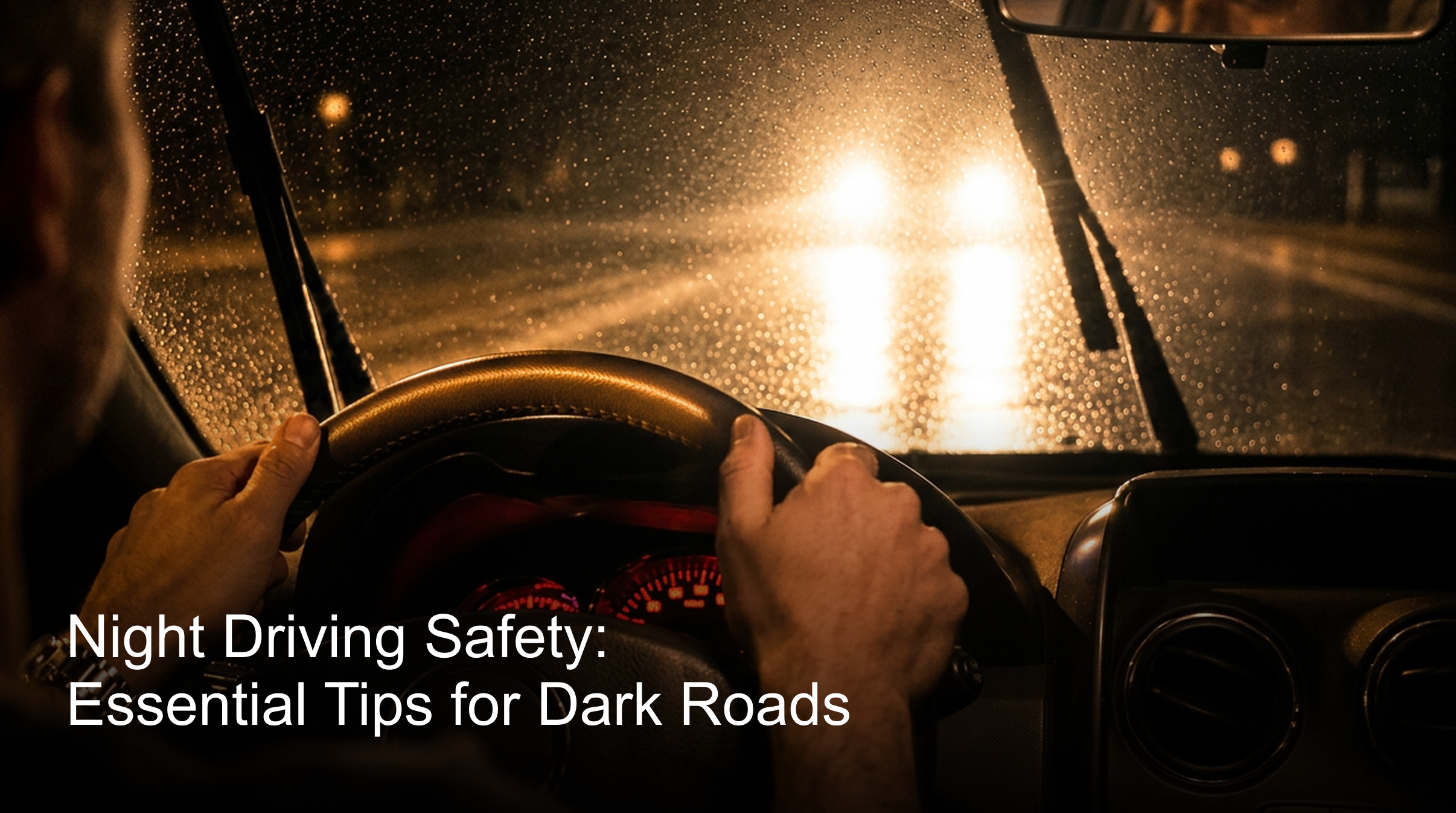
Try picturing you’re driving on a quiet highway at night. You are driving at night on a poorly lit street, and you see a person riding a bicycle just a few seconds before you overtake them. Situations like this are why night driving safety needs to be emphasised. Night driving poses a much greater risk than daytime driving due to lower visibility, higher levels of fatigue and the importance of reaction times.
Luckily, driving at night doesn’t have to be stressful. Many of the dangers of night driving can be minimised if the proper precautions are taken, the vehicle is properly maintained, and driving skills are used properly. This includes learning why night driving is more risky to how to use lights properly, slow down, deal with glare and know when to turn off and rest.
Why Is Night Driving More Dangerous Than Daytime Driving?
Maintaining night driving safety is much more difficult after sunset due to lack of visibility, loss of depth perception, and fatigue setting in easily. The night period of 6 pm to 6 am was responsible for more than 2.24 lakh accidents in India’s total of 4.61 lakh road accidents.
- How Does Darkness Affect Your Vision and Reaction Time?
Peripheral vision and colour contrast become poorer after sunset, making it difficult for motorists to see any pedestrians, cyclists, or even stray cattle near the roadside. This also affects depth perception, making it more difficult to gauge the speed of oncoming vehicles. This means that since the hazard appears at a relatively shorter distance, the time available to respond to the hazard decreases. This is one of the main reasons why night driving safety cannot depend on instincts alone.
- What Role Does Driver Fatigue Play at Night?
Natural sleep rhythms of the body make one feel more sleepy between midnight and 6 am, thereby reducing concentration levels and slowing down reaction time. Prolonged driving can make one even more fatigued, resulting in lapses in concentration and making night driving very dangerous.
Night driving safety begins with having enough rest before setting out. If one is tired, then it would be prudent to postpone the drive, take some rest, and make plans to take breaks every two hours during long drives. When driving at night, another person could share the drive with you.
What Are the Essential Night Driving Safety Tips?
Night driving safety is based on a few well-disciplined practices that must be followed on all night drives. Here are a few rules that have been numbered for easy reference before beginning your drive.
- Turn on your headlights at dusk rather than at nightfall. It will take about 20-30 minutes before dusk to give more time for others to see you in transitioning light.
- Increase your following distance to 4-5 seconds. The braking distance at night feels shorter than what it actually is.
- Do not overdrive your headlights. Maintain a speed at which you can come to a halt before reaching the point where your lights shine.
- Dim your headlights for approaching and preceding traffic. Having your high-beam lights on will blind other drivers and increase accident chances.
- Ensure that your windscreen, mirrors, and lights are clean. This is because even the smallest dust or spot will increase glare and decrease your visibility.
- Rest for 20 minutes after every two hours when you drive in darkness. Your fatigue levels build up quickly when driving at night.
1. How Should You Use Your Headlights at Night?
Switch on your headlamps before sunset because most accidents take place in this period of the day. Make sure your headlamps are clean and well-adjusted so that you have enough visibility without dazzling other drivers. If you see any oncoming traffic, switch from high to low beams as soon as possible. Night driving safety will involve dipping your lights immediately when you see other motorists.
2. What Is the Safe Following Distance at Night?
During the day, the general recommendation is a 3-second following distance from the car ahead of you. During nighttime, the following distance is recommended to be 4 to 5 seconds. This is necessary since darkness prevents the driver from recognising the presence of hazards and the activation of the brake lights on the car ahead of you. Increasing the gap is one of the easiest methods to create reaction time for night driving safety.
3. How Fast Should You Drive on Dark Roads?
Speed should be tied to the range of your headlights and not the speed limit; don’t ever overdrive your headlights. High beams will light up 100 meters, and low beams will light up 50 metres. If your stopping distance is beyond the range, then you are driving too fast for sound night driving safety practices. As an example, the maximum speed during nighttime should not exceed 60 kilometres per hour.
How Do You Handle Glare from Oncoming Headlights?
The glare caused by the headlights of approaching vehicles temporarily blinds you, and it may take several seconds for your night vision to be restored, hence being a major factor behind accidents at night. An important night driving safety tip is looking towards the left side of the road or lane marking instead of staring into the lights. Adjusting the rear view mirror to night mode helps reduce the glare without compromising the view of traffic behind you.
- High Beams vs. Low Beams: Which Should You Use and When?
The road conditions and traffic should determine whether high-beam or low-beam light should be used. The following table shows when each should be used.
| Beam Type | Range | When to Use | When to Switch Off |
| Low Beam (Dipped) | 50 metres | City roads, traffic, or when following another vehicle | This is your default; always revert to low beam once high beam is not required |
| High Beam | 100 metres | Empty, unlit rural roads or highways with no vehicles ahead | Within 200 metres of an oncoming or leading vehicle |
The rule that should always be followed: use high beams only on deserted and dark roads, dipping the lights at 200 metres from another car.
- What If Oncoming Drivers Do Not Dip Their High Beams?
In case the approaching vehicle does not lower its headlights, then one needs to reduce the speed and not stare directly into the light. Focus on the left side of the street while holding the position until the vehicle passes. One should not use the high beams as retaliation since this would mean blinding both drivers and creating a hazard for night driving safety.
What Night Driving Precautions Should You Take Before Leaving?
The basis for night driving safety starts even before getting into the car. A simple procedure that includes a light check, windscreen, tyres, fuel, and sleep will prevent most problems experienced on the road.
1. Quick Pre-Drive Checklist for Night Journeys
Check off this list before each night trip as part of proper night driving safety.
- All headlights, taillights, indicators, and brake lights are operating properly.
- The windscreen, rear glass, and mirrors are clean, inside and out.
- All tyres are inflated to the correct pressure, including the spare tyre.
- The fuel tank has adequate reserves for the entire journey.
- The driver is well-rested and not driving during alertness hours.
- The wipers and washer fluid are fully topped up in case of rain or dust.
- There is an emergency kit containing a torch, a reflective triangle, and some basic tools in the trunk.
2. Should You Plan Your Route and Fuel Stops in Advance?
It is wise to map out the locations of fuel stations, toll plazas, and rest areas even before setting out, because most of the pumps and dhabas shut down at night in small towns. This is sensible planning, not an inconvenience, and a basic part of night driving safety.
How to Recognise the Warning Signs of Drowsy Driving
Drowsiness while driving tends not to announce itself clearly but builds up through little warnings. These may include:
- Eyelids that are heavy or sagging, causing trouble keeping your eyes open.
- Falling out of your lane or being unable to stay in one place on the road.
- Not noticing familiar turns or exits, even when you know where you’re going.
- Having no recollection of the last few kilometres of the trip.
- Finding yourself yawning all the time and unable to concentrate on driving.
Caffeine, music, or rolling down the window can be tempting, but no amount of these will restore the reaction time that has been lost. This is among the least realised facts when it comes to night driving safety, precisely because the warnings tend to be quite subtle.
- How to Take a Safe Break at Night
Whenever you need a rest, select a brightly lit fuel station or a proper rest area, not a roadside stop. Make sure that you park completely off the highway, secure your vehicle, and have a 20-minute sleep or pass the driving responsibility to another person when possible. Stopping right there on the road, even on the highway shoulder, is much more hazardous than driving further to some safer destination, and this must be included in every night-driving safety strategy.
Planning a Late-Night Drive? Rent a Road-Ready Car from Revv
A very important factor in night driving safety is determined even before the engine starts running. Brakes in good condition, properly aligned headlights, well-conditioned tyres and a clean windscreen add greatly to safety, just like safe driving.
Those individuals who intend to travel late at night but want to avoid being responsible for maintaining their vehicle themselves can find the cars offered by Revv fully serviced, with basic insurance and maintenance covered. In this case, there is no requirement for a late-night pickup, and the driver can pick a car based on his route, whether it be a hatchback for the city or an SUV for the highway.
Conclusion: Prepare, Stay Alert, and Drive with Confidence After Dark
Driving at night does not have to be about taking chances. Night driving does not have to be a matter of luck. When using the headlights properly, maintaining a proper distance behind other vehicles, driving at a reasonable speed, and acknowledging one’s exhaustion, most of the risks involved in night driving safety can still be within the driver’s control. A good checklist prior to the trip and sufficient stops along the way make for safe night driving. If you need a reliable car for your next trip, opt for a well-maintained car rental from Revv and have better peace of mind.
Frequently Asked Questions
Q1: What is the safest way to drive at night?The best way would be a combination of proper use of headlights, a 4-5 second following distance, and maintaining speed within the range of headlights. Being well-rested is as important as any technique.
Q2: Should I use high beams or low beams at night?High beams should be used only on deserted roads with no traffic ahead, as their range is around 100 metres. Oncoming traffic should be switched to low beams 200 metres before another vehicle.
Q3: What is the recommended following distance at night?Double your regular 3-second daylight distance margin to 4-5 seconds at night because it takes longer for drivers to spot potential dangers in darkness. It is an essential aspect of night driving safety that helps recover the lost reaction time.
Q4: How do I deal with glare from oncoming headlights?Do not stare straight into the lights coming toward you, but rather look towards the left side of the road. Reduce speed a little bit, as it may take up to several seconds to recover your eyesight.
Q5: When should I stop driving at night and take a break?As soon as you notice heavy lids, drifting from your lane, or difficulty remembering the past few kilometres, pull over. Either stop for at least 20 minutes at an illuminated fuel stop or rest area, or change drivers.
Q6: What night driving precautions should I take before leaving home?All lights must be checked, the windscreen must be washed and the mirrors cleaned, and the tyres checked along with fuel before beginning a journey. Adequate sleep and route planning constitute proper night driving safety.
Q7: Is it safe to drive on Indian highways at night?Yes, but only if the driver is able to adjust his or her driving accordingly through slower speed, greater following distances, proper headlights, and appropriate rest stops. There are some specific dangers that Indian highways pose at night.